

GPU servers and their Impacts on AI Research and Development.
The pace at which AI research and development (R&D) is evolving is more rapid than ever before, as more data sets, more complex neural network architectures, and the need to have rapid experiments have grown. The traditional server setups are slow to follow since they will not be able to offer the processing power to support the compute intensive tasks and the flexibility to support team research. The high-density GPU servers have been the game-changer as it has solved these pain points by incorporating more processing power into a small area.

Parallel Processing, or rather, Unmatched: Model-Iteration Acceleration.
Model training and testing is the most basic element of AI R&D and is founded on parallel processing to compute huge volumes of data. The high density of the gpu servers combine a few cores of the gpus into a single unit thereby giving them the capability of executing thousands of calculations in parallel. This parallelism cuts training a model to a bare minimum: what would have taken weeks with the traditional servers can be trained in days or even hours to date. An example of a study on the development of an AI model to predictive maintenance in the manufacturing industry can similarly undergo 3x more design variations within the same timeframe accelerating the prototype to deployment process. Optimally, Aethlumis has made these servers compatible with the HPE, Dell and Huawei hardware and that the GPU resources are not wasted without compatibility bottlenecks, which are crucial in relation to R&D teams where a minute of downtime is an entire progress loss.

Greater Collaborative Effectiveness: Research Teams Empowerment.
Research and development of AI is almost never a one-person project; teams of researchers, engineers, and data scientists must be capable of sharing resources and collaborating in real-time. High density GPU servers offer multi-user accessibility whereby, a group of more than one user can be using a single server to conduct experiments, test algorithms and results analysis simultaneously. This will eliminate the isolated hardware setups and wait times to resources. One example: a financial R&D team that is building algorithmic trading models may have data scientists testing feature engineering algorithms and engineers testing the performance of the models all co-located on a single high-density server. Aethlumis secure system integration, which is built in, makes it possible to ensure the privacy of the data when collaborating with each other and timely technical support of experts will not cause inconvenience when accessing or functioning, and the processes of the research will not be discontinued.
Optimized TCO: Performance vs. Affordability.
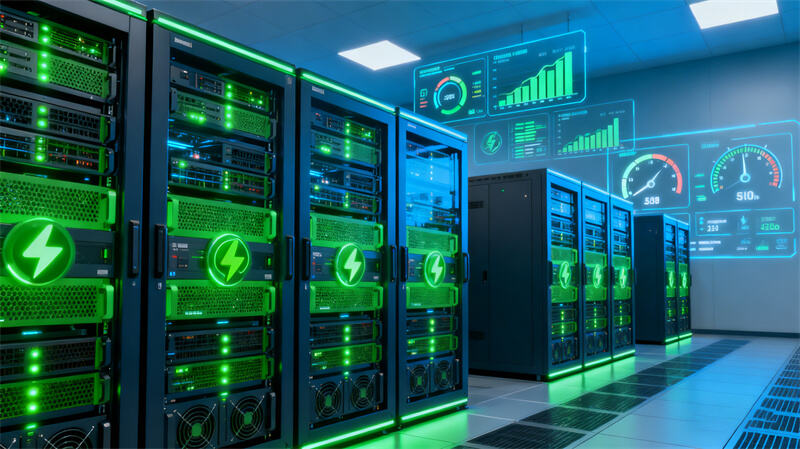
The AI R&D budgets are often constrained, and cost efficiency is among the central aspects. The type of server, known as high density server, is very beneficial in TCO, since it is given maximum advantages in terms of power to compute per square foot and restricts the amount of power consumed. The high-density systems save the space requirement in the data center by up to 40 percent compared to the sparse traditional server farms which save the rent, cooling, and the infrastructure expenses. In addition to that, their power delivery is optimized (they use our partners energy-efficient hardware) and saves 20-25% of the electricity consumption with no effect on the performance. Considering the example of energy sector R&D organizations focused on AI-based models of predicting renewable energy, it means that they will need to spend more money on innovation, rather than operational expenses.

R&D Benefits that are industry specific: Customized by Aethlumis.
The astute understanding of finance, manufacturing and energy business by Aethlumis results in the high-density GPU servers being modified to meet special R&D demands:
Finance: Low latency and secure processing of high-density servers is a useful asset in risk assessment model or fraud detection algorithm R&D since it can be tested rapidly on complicated situations and meets high standards of regulations.
Manufacturing: To build AI-driven quality issues or production optimization solutions, high-density GPUs are used by teams to process sensor data in real-time to produce solutions that minimize defects and maximize efficiency.
Energy: The high-density servers speed up the research on grid optimization and predicting renewable energy management by variable data sets on solar panels or wind turbine to optimize the model that maximizes the utilization of their energy and sustainability.
Conclusion
High-density GPU server is changing the AI R&D concept by offering unprecedented processing power, greater collaboration, and affordability, which is necessary within the organizations, which are interested in staying competitive in the market. The collaboration with HPE, Dell and Huawei ensure that Aethlumis servers are built based on the reliable and innovative hardware, and the integration of the system, interest in green technology and the knowledge of particular requirements of the world of finance, manufacturing and energy make sure that Aethlumis servers meet the demands of all these spheres. High-density GPU servers are not just hardware to AI R&D teams, but it can be an engine to faster innovations, smarter experiments, and more meaningful results.
Table of Contents
- GPU servers and their Impacts on AI Research and Development.
- Parallel Processing, or rather, Unmatched: Model-Iteration Acceleration.
- Greater Collaborative Effectiveness: Research Teams Empowerment.
- Optimized TCO: Performance vs. Affordability.
- R&D Benefits that are industry specific: Customized by Aethlumis.
- Conclusion