

We are also at the edge of implementing advanced infrastructure in critical areas at Aethlumis through our deep relationship with world technology leaders such as HPE, Dell, and Huawei. There is one architectural technology in the field of artificial intelligence which has become essential in the construction of the super-computing systems that power AI today: the OAM (Open Accelerator Module) GPU server. This is not another hardware, but the backbone on which the scale, performance, and efficiency of the most-challenging AI workloads of our time are built.

The Standardization and Density Drive.
The sheer scale of AI models, specifically of Large Language Models (LLMs) and more complex neural networks has made old-fashioned server architecture designed to be used with simpler models unfeasible. The models require an unprecedented amount of parallel processing power and this requires dozens, and occasionally hundreds of GPUs being cohesively integrated into a system. OAM is an important open standard that is an open system that splits the GPU accelerator and its proprietary form factor. This standardization, pioneered by industry consortia, enables vendors such as NVIDIA, AMD and others to develop high-performance GPUs that can fit into a standard streamlined chassis. To our clients in finance, manufacturing and energy, it means that they can create large, high-performance computing clusters without being bound to a single vendors ecosystem, allowing them to be flexible and future-proof their investments.
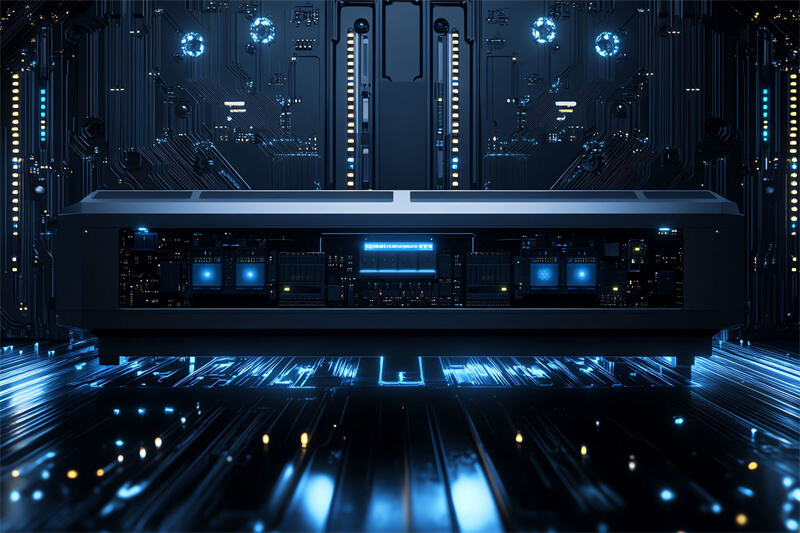
Conquering the Interconnect Bottleneck.
There is no use having raw computational power, which cannot communicate in extraordinary speeds, the GPUs. Even a single server with a few GPUs cannot be used to train a trillion-parameter model. The real genius of the OAM architecture is that it is combined with ultra-high-speed and low-latency interconnect fabrics such as NVLink and NVSwitch (in the NVIDIA ecosystem) or analogs. OAM servers are specifically implemented to support direct communication between the GPUs in the entire rack of modules without involving slower traditional PCIe paths. This establishes an enormous single accelerator in which terabytes of simulation data may be exchanged in virtually real-time. This is what makes a set of computers with individuals into a real, monolithic AI supercomputer. It directly allows the effective, punctual delivery of projects without which it would not be possible to achieve them.

Thermal and Power Design: Scale Engineering.
The large power density in a single rack poses significant thermal and power problems. OAM server is not just a box of GPUs: it is a masterpiece of system-engineering that is concerned with long-term performance. These systems are designed with advanced and coordinated cooling systems, usually direct-to-chip liquid cooling, which is efficient in dissipating heat up to power draw in the kilowatts. This is so that GPUs are capable of sustaining boost clocks over long durations, which is inalienable in training programs that persist over weeks. Moreover, the integrated power design offers stable power at large scale and clean. This translates into reliability and less of a risk of downtime to our clients in case of critical, long-duration AI training or large-scale inference operations.

The Scalability of Artificial Intelligence.
Finally, the OAM form factor is the unit of scalable AI infrastructure. It enables accumulation of data centers to shift to a scale-out approach in acceleration instead of scale-up. A pod can be assembled by connecting individual OAM modules and a supercomputing cluster can be assembled by connecting pods. Our experience in system integration with our partners, such as HPE and Huawei, allows us to offer this modularity to enable organizations to develop AI capabilities in a very effective step-wise process and according to their needs. It provides the performance and reliability needed by sensitive industrial and financial AI applications, ranging through generative AI and real-time fraud detection to multifaceted and digital twins, and predictive maintenance simulations.
Conclusively, OAM GPU servers do not constitute merely an upgrading. They represent a paradigm shift in data center design and are designed with the express aim of overcoming the particular bottlenecks of AI supercomputing. They offer the basic three ingredients of standardized density, breakthrough interconnectivity, and effective thermal management, which create the unbreakable foundation on which the future of AI is being established. We use our alliances and technical expertise to provide and maintain this underlying infrastructure at Aethlumis to enable our clients in the finance, manufacturing and energy industries to innovate efficiently and with confidence.